A Meeting of Souls illustrates Curt Cacioppo’s connection with great music of the western canon. It originated as a commission from the Carmel Bach Festival for a piece that would substitute the famous “Air on the G String” in their performances of the Bach IIIrd Orchestral Suite, and elliptically is based on that ubiquitous 18 bar string movement. Cacioppo became so fascinated with the “Air” that he produced two other response pieces, one of which is the finale of his “Fantasy, Air and Rag” triptych for 2 pianos in tribute to J.S. Bach, and “Midsummer Air,” also for the Carmel Bach Festival Orchestra.
Viaje: Zhou Tian
“Viaje”(Spanish for voyage) was commissioned by Dolce Suono Ensemble and premiered by Mimi Stillman, flute and the Dover Quartet in 2015. Mimi Stillman premiered the flute and string orchestra version of “Viaje” with the Chamber Orchestra of the Triangle (NC) in 2016. Experiencing Spain for the first time and learning about the stories of Spanish legend El Cid inspired me to compose this 9-minute thrill ride of bittersweet. I was particularly drawn to the relationship between Cid and his two daughters, as they went through an innocent childhood, separation, distrust, and finally, reunion. I imagined the flute to be the voice of daughters, and the cello representing the voice of father. A musical dialogue between the two emerges in the middle of the piece, as if recalling a long-overdue conversation between father and daughters. It wasn’t until the piece was finished that I realized that I had unconsciously married my musical roots as a Chinese-American with my new found love of Spanish music.
Described as “absolutely beautiful” and “utterly satisfying” (Fanfare), the works of Chinese-born American composer ZHOU Tian (JOH TEE-en) have been performed by major orchestras in the United States and abroad, including the Minnesota Orchestra, the Pittsburgh Symphony, the Indianapolis Symphony, the Houston Symphony, the Hong Kong Philharmonic, and by leading soloists and ensembles such as Yuja Wang, Roberto Díaz, Jason Vieaux, the Eroica Trio, the Arditti and Dover string quartets, the Empire Brass, and the Tanglewood Festival Chorus. His newest work, “Concerto for Orchestra,” (“stunning…tonal and engaging” —Cincinnati Enquirer), commissioned by the Cincinnati Symphony, premiered in the orchestra’s 2015-16 season finale, conducted by music director Louis Langrée. The work was released in the CSO’s latest recording “Concertos for Orchestra” in Fall 2016. Critically acclaimed for his lush and distinctive musical voice, Zhou’s music has been performed at prestigious venues such as Carnegie Hall, Lincoln Center, and Kennedy Center for the Performing Arts, and broadcast on NPR and PBS. His large-scale symphonic suite for soloists, orchestra, and chorus, “The Grand Canal,” was performed during a nationally televised celebration of the 60th anniversary of the founding of the People’s Republic of China. He holds music degrees from Curtis (B.M.), Juilliard (M.M.), and USC (D.M.A.), is a first-prize winner of Washington International Composers Competition, and held composition fellowships from Tanglewood and Aspen music festivals. He is an associate professor of composition at Michigan State University College of Music. Visit ZhouTianMusic.com for more.
Concert Photos 2/2016 at Swarthmore

Charles Abramovic, pianist

Charles Abramovic, pianist

James Freeman conducting Chamber Orchestra FIRST EDITIONS

James Freeman conducting Chamber Orchestra FIRST EDITIONS
Two Haunting Elegies and Mozart: Salzburg 1776 to Vienna 1784
 Saturday, September 24, 8 PM
Roberts Hall, Haverford College
Sunday, September 25, 8 PM
Lang Concert Hall, Swarthmore College
- W.A. Mozart, Serenata Notturna, K. 239
- New work, For the Uprooted, by Janice Hamer
Lori Barnet, cello - Lamentation, for Oboe, String Orchestra, and Three Angels
by Arne Running - W.A. Mozart, Piano Concerto in E flat Major, K. 449
Marcantonio Barone, piano
Both concerts free and open to the public without ticket
How does a personal calamity, an international disaster, or just the passage of years affect a composer’s music? How does Janice Hamer deal with the tragedy of refugees fleeing war and poverty in “For the Uprooted?” How does Arne Running express the inner turmoil of his personal life in his “Lamentation”? What circumstances led Mozart to interrupt his work on the piano concerto we now list as K. 449, finally completing it more than two years later? Can we see his progression as a composer from the “Wunderkind” years of the “Serenata Notturna” to the mastery of K. 449, or even in the two years that separate the movements of K. 449? What makes a composer “tick”? We hope you’ll join us to ponder these questions or just sit back and enjoy a compelling combination of early Mozart and new music.
W.A. Mozart, Piano Concerto in E flat Major, K. 449
February 9, 1784, was an especially significant day for the 28-year-old Mozart. On that day he finished writing the E flat Piano Concerto, K. 449 (probably begun two years earlier) and made it the very first entry in a new catalog of his works. He maintained this catalog throughout most of the rest of his life, adding the titles of new works, together with the dates on which they were completed, and musical incipits of one or two measures written on two staves.
In this catalog Mozart indicated that the instrumentation for what we now list as K. 449 included 2 oboes, and 2 horns “ad libitum,” that is, with optional winds. And in a letter to his father he added that the concerto could be performed “à quattro ohne Blasinstrumenten,” with the usual four orchestral string parts (two violins viola, cello/bass) but without winds. It is this version of the piece that COFE performs this evening. “À quattro” has also been taken to mean that the piece could be performed with just four string players, as chamber music.
Three years earlier, in 1781 at age 25, Mozart realized he could no longer abide living and working in relatively provincial Salzburg. As a court employee, he felt his talent was being wasted, and he deeply resented what he considered the musical and social bondage that entailed, as well as the constraints on pursuing his career. Against his father’s wishes, he submitted his resignation, and until his death in 1791, without the financial safety net of a court appointment, his life and work were centered almost entirely on Vienna.
In 1782 he wrote a set of three piano concertos (K. 413, 414, 415), his first concertos for Viennese audiences. In these three concertos the wind parts are “ad libitum,” suggesting a possible relationship between them and the later K. 449. (All of Mozart’s concertos after this time include prominent and obligatory wind parts.) Recent scholarly investigations into the various kinds of paper Mozart used during his lifetime corroborate the idea that K. 449 was indeed begun in 1782. The beginning of the piece only is written on the same kind of paper Mozart used for some of the earlier concertos of 1782. The rest is on paper datable to 1784. For whatever reasons, Mozart seems to have abandoned work on this concerto for two years, finishing it only in time for him (and his pupil Barbara von Ployer to whom it is dedicated) to perform in Vienna. Perhaps he felt the three concertos of 1782 constituted a complete set to which K. 449 did not really belong, setting it aside until an occasion arose for completing it.
As with the Concerto K. 271 which COFE performed this past February with pianist Charles Abramovic, Mozart wrote out a first-movement cadenza for the soloist. We can assume that this was for use by Fräulein von Ployer (as it had been for K. 271’s Frau Jenomy), since he himself would certainly have improvised his own cadenzas. Otherwise the two pieces are very different. K. 449 is less overtly dramatic, more gallant, more genial, more intimate. As Mozart wrote to his father, “It is a concerto of a very special kind, written more for a small orchestra than a large one.”
Mozart clearly slipped easily back and forth between boldly asserting his musical independence from his contemporaries and predecessors, and accepting them and their basic style as models on which to build. This may have been due to his own mood at any one time, but more probably was related to the nature of the specific circumstances, audiences, performers. When he wanted to please and entertain an audience with lighter music like divertimenti, he seems to have done that with great ease and little effort. When, for especially important audiences (operas), performers (symphonies and concertos), or publications (chamber music) he wanted to make a statement about his genius and the miraculous things it could produce, he exerted himself to his fullest. It is perhaps in the last great fourteen piano concertos (K. 449 of 1784 to K. 595 of 1791) that that genius shines most clearly, for these were very public works for significant audiences, but even more important, they were invariably written with Wolfgang himself in mind, as a pianist as well as a composer. – James Freeman
W.A. Mozart, Serenata Notturna, K. 239
The terms “serenade,” “divertimento,” “partita,” and “cassation” were all virtually synonymous for late 18th-century composers, describing light compositions of several short movements, designed for outdoor entertainment. “Notturno” signified only that the piece was intended for an evening’s entertainment.
Mozart’s “Serenata Notturna” is nonetheless an unusual piece. It combines a string orchestra with timpani (but without timpani’s usual companion of two trumpets) with a solo concertante string quartet whose lowest voice Mozart’s indicates as “basso,” not “violoncello” which instead appears as the lowest written voice in the orchestra. (The double bass, or “Violone,” then actually provides the true sounding bass, an octave below the cello, for both the quartet and the orchestra.) The piece hearkens back to the baroque concerto grosso, with all three movements focusing on the alternation and interchange of the solo quartet and the orchestra. The three movements themselves are unusual – a march, a minuet with trio, and a rondo – more compact than the usual five or six movements of most serenades and divertimenti. The third movement, “Rondeau,” is especially charming with its sly returns of the rondo theme, introduced in our performances (as we imagine would surely have taken place with Mozart’s own orchestra) by quasi-comical lead-ins to the principal theme.
Mozart’s manuscript indicates the piece was completed in January 1776. Given the time of year, it was probably written for an indoor entertainment of some kind. But what might that occasion have been? Is it possible that Mozart (born January 27, 1756) wrote the piece for a party celebrating his own 20th birthday? Might that explain the fact that the “Serenata Notturna” is a special, quite unique piece, among the multitude of occasional works for entertainments of various kinds he wrote throughout his life? – James Freeman
Lamentation, for Oboe, String Orchestra, and Three Angels: Arne Running
Arne Running’s 1991 Program notes for “Lamentation”
When James Freeman asked me to write a piece for Orchestra 2001, the request came at a time when I was experiencing considerable distress. An event had recently occurred in my life which created intense inner turmoil. There are many tools a person can use to work through a personal crisis: the composing of “Lamentation” became one such tool for me.
In “Lamentation,” I have tried to express sorrow – sorrow born of spiritual conflict and loss of illusion. The music also contains passages representing violent anger. (Of all the Italian expression markings appearing in the score, it is the word violento which recurs most frequently – a total of twelve times .
The music begins quietly, and the first section works towards a violent climax. The middle section is a dialogue between Three Angels (represented by three trumpets) and an opposing spiritual force (represented by the low strings). The section reaches a climax which is both triumphant and violent, after which there is a reappearance of the quiet music heard at the very beginning. The work concludes with a brief, gentle “hymn” – and finally, quiet acceptance of life’s unresolvable mystery. – Arne Running
James Freeman’s story of Arne Running and “Lamentation”
“Arne Running was a Philadelphia treasure. As composer, conductor, clarinetist, and human being, he was truly legendary. One of the finest musicians I’ve ever known, Arne was perpetually – almost relentlessly – working on improving all his musical skills. Testing clarinet reeds, mouthpieces, instruments, new fingerings, embouchures, were unceasing ongoing pursuits. But he was continually challenging every other aspect of his musical being as well, always with an aim to being an even more perfect and skilled artist. He loved music with all his heart and was never satisfied with just being a terrific and much admired clarinetist, composer, conductor. There was always a higher plateau he felt he needed to reach. He provided a model for all of us to follow, and I think everyone who knew him has benefitted enormously from that model and from knowing this immensely talented and humble man.
Dorothy and I had known Arne very slightly when we were all students in Boston. It was a great joy for us to become close friends with him once we were together in Philadelphia. When we saw Arne and Nancy’s devotion to their beloved Springer Spaniel Sam while they visited us at home, we realized how much they reflected our own feelings for our new assortment of English Cocker Spaniel puppies, and that bond became even closer.
In 1991 I asked Arne to write a new piece for Orchestra 2001, then in only its third year of existence. The result (which he dedicated to Dorothy and me) was “Lamentation for Oboe, String Orchestra, and Three Angels.” (The angels become three trumpets in the piece itself.) We premiered the work in October of that year with the composer conducting. I think it is an immensely powerful and moving masterpiece. Said the Welcomat’s music critic Tom Purdom, “Arne Running’s brand-new Lamentation . . . is a series of darkly beautiful musical gestures unified by a strong personal emotion. The heart of Running’s Lamentation is a lengthy oboe solo – beautifully played by Dorothy Freeman – that’s surrounded by muted trumpets, somber cello interludes and tender ultra-high melodies for the first violin.”
Curiously, Arne never listed the piece among his works on his website. Also, we do not know of any later performances of the piece. I can only speculate that the “Lamentation” was so personal an expression of dismay and grief, for whatever reason, that he did not want it to circulate. There is a mystery here that we may never be able to decipher.
About a year ago, I asked Arne if he would write a new 5-8 minute piece for string orchestra for the Chamber Orchestra FIRST EDITIONS concerts coming up in September 2016. Arne was ill at that time but he still hoped he would be able to complete the work. He sent me a small handful of measures during the winter but it was not enough to give one an idea of what the piece might eventually become. Then, sadly, there was no more. Arne passed away in March 2016. We are honored to revisit the “Lamentation” from 1991, twenty-five years later, in order to replace what I am sure would have been a wonderful new piece. We think there could not be a more appropriate replacement and we dedicate this performance to Arne’s memory.” – James Freeman
For the Uprooted: Janice Hamer
For the Uprooted has no dramatic program, traditional form or systematic method. The music seemed to arise as a response to the turbulence of our current world, and its destabilizing effect on countless lives.
Maestro Freeman offered the option of referring, in the commissioned work, to Mozart’s K.449, performed in this concert by my friend and colleague Marcantonio Barone. I have fleetingly done so, evoking a melody from the Andantino of the concerto, which in turn quotes—deliberately or not?—a movement from Bach’s Cantata 140, “Mein Freund ist mein.”
I dedicated this piece, with deep gratitude, to James Freeman and Lori Barnet. Freeman’s invitation encouraged me to “get back on the horse” after a non-composing period. The idea of a solo cello part for Lori Barnet occurred to me after I accepted the commission. She has played a significant and generous role as midwife to innumerable new works by Philadelphia and Washington composers, including several of mine. – Janice Hamer
Janice Hamer, composer
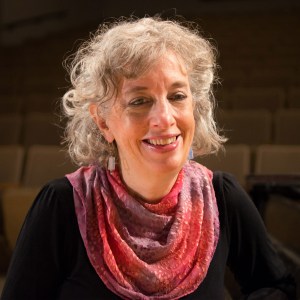
Janice Hamer’s music includes solo vocal, choral, orchestral and chamber works, and an opera, Lost Childhood, based on a Holocaust memoir. Her music has been performed in England, France, Austria, Israel, the Palestinian Authority and Ukraine, and by various groups in this country. She is the recipient of numerous awards, including a Radcliffe Institute Fellowship, grants from the New Jersey and Pennsylvania Councils on the Arts, Meet the Composer, American Music Center, American Composers Forum and ASCAP, and she has had five residencies at the Virginia Center for the Creative Arts. She has degrees from Harvard and Westminster Choir College, and a Ph.D. from the Graduate Center of the City University of New York. Her teachers were Earl Kim, Peter Maxwell Davies and Thea Musgrave.
A longtime Philadelphia resident, Hamer taught at Swarthmore, and earlier at Curtis and Haverford. She currently lives in the Washington D.C. area. In addition to her musical activities, she has recently organized a project to introduce solar cooking to several Tanzanian villages.
February 23, 2016 – Premier concert
Philadelphia Inquirer, David Patrick Stearns – Full Review
Expectations turned upside down at the debut concert of First Editions Chamber Orchestra, newly formed by James Freeman, the man who retired from Orchestra 2001 after 27 years, but who hardly seems through with the new-music business. Premieres by Cynthia Folio and Heidi Jacob were on Sunday’s concert. . . . But another part of the ensemble’s mandate is performing early Mozart. . . .In the slow movement [Piano Concerto K. 271], Freeman was after 19th-century intensity without ruffling the piece’s 18th-century outer garments. It worked. He seemed swept up with Mozart in ways that should have happened years ago. Piano soloist Charles Abramovic. . . colored the music’s sequential repetition with great insight. Abramovic often went beyond mere grace and poetry, turning the cadenzas into miniature epics.
The Swarthmorean, Pete Prown – Full Review
Conductor James Freeman is familiar to admirers of Swarthmore College’s resident ensemble Orchestra 2001 (which he founded and served for 27 years as artistic director), but on Friday he brought his latest classical venture to Lang Concert Hall, the Chamber Orchestra FIRST EDITIONS. This ensemble serves to contrast the early work of Mozart with edgy contemporary music in a way that’s both aurally pleasing and educational. . . . The interpretation of early classical-era work was rapturous. . . . After intermission, maestro Freeman brought out the acclaimed pianist Charles Abramovic to perform Mozart’s beloved Piano Concerto in E flat major. With his keyboard virtuosity rippling through the air of Lang Hall with superb accompaniment from the musicians (including several students from area colleges), it was hard not to appreciate the larger context of the moment. Not only did the audience enjoy wonderful music, but it was all presented on a quiet afternoon for free. As the lights went up and the applause subsided, we were already looking forward to future concerts from the superb Chamber Orchestra FIRST EDITIONS.
 chamberorchestrafe.org